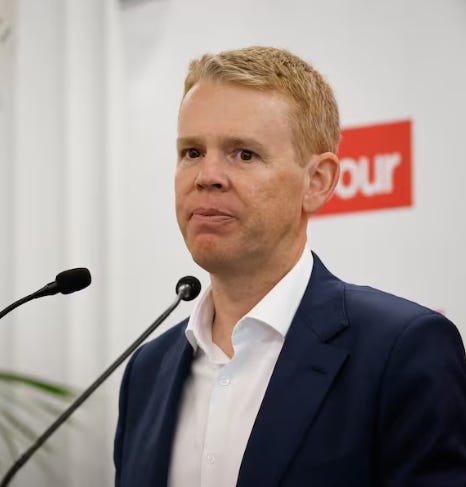

When Chris Hipkins succeeded Jacinda Ardern as Prime Minister in January 2023, he adopted what was essentially a “smaller target” strategy.
He announced a policy bonfire to sideline some of the Labour government’s most contentious proposals — including the RNZ-TVNZ merger, hate-speech laws and the biofuels mandate. Instead, he claimed he would concentrate on “bread-and-butter” issues.
Initially, his approach worked. Labour shot up in the polls but after several months they began steadily falling. Voters realised Hipkins was not the new broom the media had implausibly portrayed him to be.
In particular, it became clear he had no intention of rejecting co-governance, which was arguably the most polarising of all the policies stealthily adopted by Labour after its landslide victory in 2020. He tried to pretend he was making significant changes to Three Waters — including by increasing the number of Water Entities from four to 10 — but voters soon twigged they were being duped. Many realised he was not serious about sweeping away the most polarising policies but rather sweeping them under the rug.
Hipkins led Labour to a crushing defeat at the election with only 26.9 per cent of the vote.
Now he’s trying a variation on the same tactic. He is again trying to persuade voters that a government he leads would be focused most keenly on “jobs, health, homes” — which is simply a repeat of 2023’s “bread-and-butter” issues. In short, once again, it appears he’d prefer not to remind the electorate the entirety of what he intends but rather concentrate on a small portion of his plans. That is to say, he is pursuing a “small target” policy.
In his address to the Labour party conference in December, he never mentioned climate change, for example, despite having pledged to overturn the oil-and-gas ban.
He made his position very clear on climate change to Newstalk ZB’s Heather du Plessis Allan in 2024 when she tackled him on the party’s commitment to 100 per cent renewable electricity, accusing him of putting the “climate ahead of jobs”.
When she asked about the number of jobs lost by banning oil-and-gas exploration, Hipkins replied: “How many jobs are we going to have if we don’t tackle climate change and the planet becomes unliveable?”
He didn’t mention Te Tiriti or co-governance in his December speech either, although — according to Peeni Henare during the Tāmaki Makaurau by-election — he has promised to reinstate the Māori Health Authority and resurrect the compulsory schools Aotearoa Histories curriculum, introduced during his five-year tenure as Education minister.
To gauge his position on Māori nationalism generally, it is worth noting Hipkins has said iwi didn’t cede sovereignty to the Crown in 1840 and has argued “there is nothing undemocratic about co-governance”.
Last February, he initially declined to firmly rule out accepting a Māori commissioner with the power of veto over Parliament’s legislation, as Te Pāti Māori’s co-leader Rawiri Waititi had suggested, referencing David Seymour’s Treaty Principles Bill as an example of the kind of initiative that could be overruled.
Speaking to RNZ the following morning, Hipkins was less hesitant, saying he didn’t agree with setting up a Parliamentary Commissioner for Te Tiriti — at least “not in the way they’ve defined it”.
However, he added: “I don’t think we should be creating a commissioner that could [overturn laws]. But we’re open to how we can make sure that there are better checks and balances within our constitutional framework.”
Although Hipkins and the legacy media generally avoid the topic, there is every reason to suspect the Treaty “partnership” and attendant co-governance policies will be enthusiastically revived in some form if Labour leads the next government.
The Māori caucus — led by Willie Jackson who is also the campaign chair for the Māori seats — is influential. Given the party intends to win all seven electorates, Labour’s candidates will be under pressure to rival Te Pāti Māori with the kind of promises Oriini Kaipara made in September’s Tāmaki Makaurau by-election. Among a series of extravagant pledges, she told The Hui that she wanted “co-governance right across the board at a local, regional and national level”.
This presents a dilemma for Hipkins since he wants to pose as a moderate compared to the radicalism of the Greens and Te Pāti Māori in the hope of attracting the soft centre.
As a taster for what may be in store under a Hipkins-led coalition, Henare also said Labour would provide $1 billion for Māori initiatives — as Ardern’s administration did in 2021.
When pressed on whether securing a billion dollars was possible, Henare replied “most definitely”.
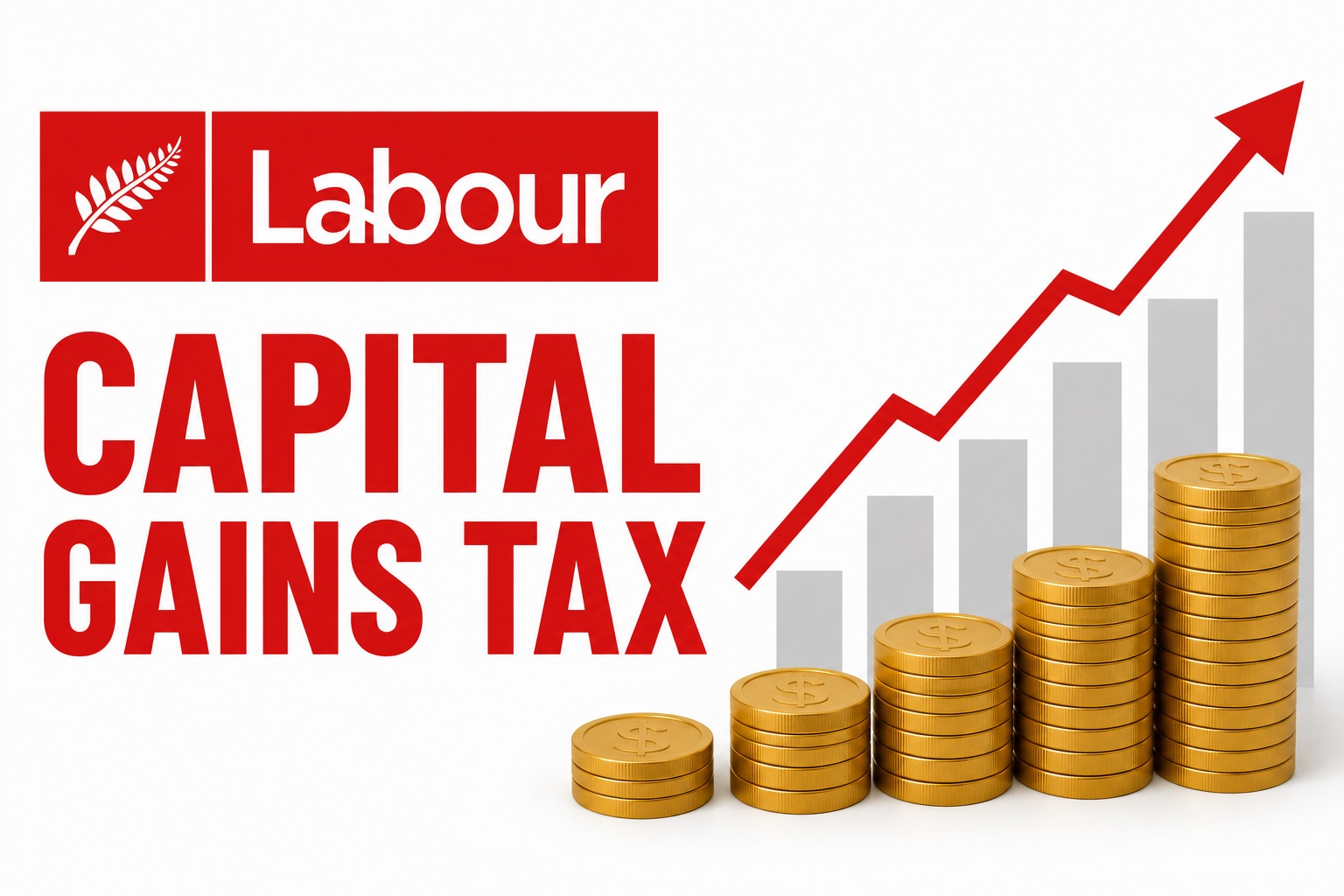
While promoting Labour’s proposed capital gains tax in November, Hipkins said there wouldn’t be any more “significant” taxes on land, inheritance and wealth announced before the election. This, of course, opens up the possibility of “significant” taxes being instituted after the election.
That might even seem inevitable, you might think, if Hipkins is obliged to form a coalition with the Greens and the rump of Te Pāti Māori, as seems likely.
The Greens have promised a suite of new wealth, inheritance and income taxes to raise some $88 billion in additional tax over four years. And while Te Pāti Māori hasn’t indicated exactly how much extra revenue it would extract, it is dedicated to a wealth tax, higher company tax rate and a foreign companies tax.
Among Hipkins’ attempts to apologise for the bungled plans of the Ardern era and his own role in them, he has admitted that Labour made promises in 2017 — including a light rail project in Auckland and 100,000 new houses under KiwiBuild — it couldn’t deliver.
In December, he told the party conference: “Every promise that I put my name to at the next election will be a promise I know we can deliver on.” Yet one of his first major promises of the election campaign has been for Labour to magic up 4.5 million extra GP appointments each year through “smarter digital tools and more efficient systems”.
The plan to offer three free GP visits annually for all New Zealanders would be financed by a 28 per cent capital gains tax on commercial and residential investment properties that wouldn’t come into operation until mid-2027 and is not retrospective.
Hipkins seems unaware of the irony of a Labour leader banking on the prices of already overvalued homes rising substantially to fund a surge in taxpayer-funded GP visits — including for the wealthy — that will undoubtedly overwhelm primary healthcare.
Labour is also proposing a “levy” on international organisations streaming content — such as Netflix, Disney+ and Amazon Prime Video — with the money being funnelled to the local screen industry.
Critics have pointed out that the levy will simply be passed onto viewers, which will effectively be a tax added to their subscriptions.
Given that Roy Morgan surveys show Netflix alone is now watched in an average month by 2.29 million viewers — or 52.2 per cent of New Zealanders — the tax is guaranteed to be widely unpopular.
And it’s not as if local productions are wildly popular. Proceeds will likely go to an agency such as NZ on Air or the NZ Film Commission to be doled out to “approved” productions. But, as the late producer John Barnett pointed out, between 2020 and 2023 the Film Commission spent about $85 million on more than 50 films that made less than $14 million in total at the box office.
Meanwhile, NZ on Air has funded no fewer than three admiring screen projects focused on Chlöe Swarbrick, despite the fact she is a sitting politician.
Pollster David Farrar’s tweet summed up much of the likely reaction: “Your streaming subs will increase to fund crap that you’d rather poke an eye out than watch sober.”
Perhaps the clearest sign that a Hipkins-led government will have to raise taxes (or borrow a lot more money) is his commitment to reinstate the pay equity programme abandoned by the Coalition government. The extra $12 billion in government expenditure will have to come from somewhere.
What makes his election strategy verge on the tragi-comic is that he is insisting Labour is determined to regain voters’ trust this year — despite now repeating the politics of omission that led them to distrust him less than three years ago.
“Strategic hibernation” — as political analyst Bryce Edwards has described the “small target” policy — may possibly work for Hipkins at the election but only as long as the public isn’t informed about the policies he is keen to hide under the rug.
ENDS