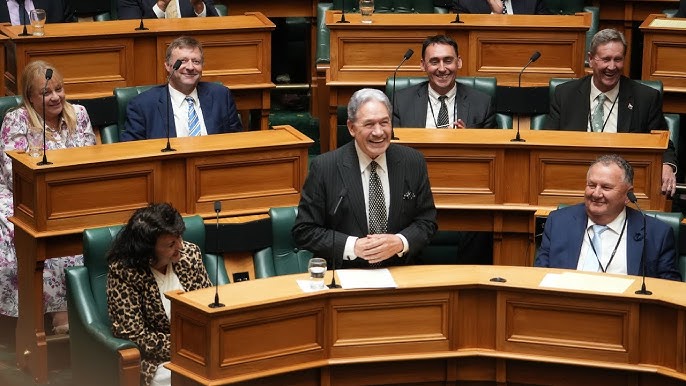

The reaction to NZ First’s English Language Bill has ranged from intense vitriol to support with reservations but it passed its first reading in Parliament this week without any votes cast against it. It now proceeds to the Justice select committee for scrutiny before its second reading.
The Justice minister, Paul Goldsmith, has endorsed it while pointing out that making English an official language wouldn’t have been a “top priority” if it hadn’t been in his party’s coalition agreement with NZ First. He meant, of course, that National regards the bill as a waste of time.
Act, which commended the bill to the House, nevertheless warned in its newsletter this week that NZ First’s move could backfire, suggesting that “putting Māori and English on the same level may achieve the opposite of what was intended”.
Meanwhile, Peters is away laughing having shrewdly launched his bill just eight months from November’s election. He guesses, no doubt accurately, that giving English the same official status as Māori and New Zealand Sign Language will be wildly popular among his conservative base — and probably among many National and Act supporters as well.
He’s not the only one chortling. Anyone watching our political and media elites throwing tantrums over a bill they have variously dismissed as “puerile” (Chris Finlayson), “pointless” (Otago Daily Times), and “bullshit” (Chlöe Swarbrick) couldn’t help but find the spectacle highly amusing.
On Tuesday, as the first-reading debate continued in Parliament after a 12-day break, Labour’s Kieran McAnulty took aim at the Prime Minister for having agreed to include the “unnecessary” bill in the coalition agreement, citing it as an example of his lack of negotiating skills. He raged against it as “cynical” and “a waste of time, a waste of resources”.
For critics to insist the bill has no point while treating it as important enough to require stern denunciation is inherently risible, although they seem not to have worked that out. If it is so pointless and a waste of Parliament’s time, why not just wave it through quickly given it is certain to become law no matter what vitriol is unleashed on it?
As it happens, the bill sailed over the first-reading hurdle unopposed, allowing NZ First to immediately gloat on X: “Waiting for Labour, the Greens and Te Pāti Māori to vote against making English an official language after spending two weeks complaining about it…”
Swarbrick takes the honours for the most extravagant overreaction so far with her speech at the bill’s initial reading on February 19 fairly described by several commentators as “unhinged”.
The fact her default setting these days is incandescent rage means it should have been hardly surprising that she would shout at her fellow parliamentarians for a full five minutes.
The Greens’ usual rallying cries packed her speech. Predictably, we heard about “oppression”, references to Māori children being beaten for speaking their language at school, and a roll call of the usual whipping boys, including Trump, the Atlas Network and Hobson’s Pledge. “Climate crisis” even made two cameo appearances — in a speech about language, no less.
In Swarbrick’s fevered imagination a language apparently has to be oppressed or threatened to warrant official recognition — which will come as news to the Canadians who have awarded both French and English official status.
Given the inevitability of the bill passing — and because it simply formalises the status quo — the smart way for the opposition to deal with it would have been to laugh it off as an election-year stunt by an elderly man in his dotage: “Winston declares water is now officially wet!”
As much as anything, the impact of the bill lies in the virulent reaction to it. Why all the hullabaloo if it is essentially trivial?
Swarbrick asserted the government “wants to stoke a fight between te iwi Māori and Pākehā, and they want that fight to be the focus of this election”.
Exactly how giving English the same official status as te reo is stoking a fight between Māori and Pākehā was not explained. Significantly, she didn’t seem to think the government was looking for a fight with deaf people — presumably because even she can see that would be very silly.
The fact that the left detects threats to Māori nationalism everywhere — even when they can’t explain exactly where the danger lies — demonstrates just how fragile and paranoid the movement actually is.
Its pathological defensiveness was on full show last year when Erica Stanford decided words in Māori wouldn’t appear in future editions of a series of books that aim to teach phonics to five-year-olds. The move was designed to avoid confusing young children but it was denounced as “racist” and “an attack on Māori”.
During the bill’s first reading, Peters made it clear its aims are modest. As well as correcting a legal anomaly, he thinks it might help reduce the relentless insertion of Māori into official documents and signage that can lead to confusion. He pointed to practical problems, citing emergency first-responders being misled by unfamiliar directions and maritime navigators needing clarity in place names.
He acknowledged it wouldn’t “solve the push of this virtue-signalling narrative completely, but it is the first step towards ensuring logic and common sense prevails when the vast majority of New Zealanders communicate in English…”
He clearly understands the resentment many New Zealanders feel at being presented with words and phrases they don’t understand via state-owned media, government departments, hospitals, universities, schools, professional bodies and others. His bill may be largely symbolic but he is cannily letting voters know that he understands their frustration over the hybrid language dubbed “Manglish”.
His opponents also understand that widespread resentment but are quick to pillory anyone expressing it as racist or ignorant, which is a very high-handed way to dismiss people simply wanting to see public documents and signs in buildings expressed clearly in English, which is the mother tongue of nearly everyone born here (including Māori themselves).
Chris Finlayson alleged the bill was “dog-whistling” — which is the term “progressives” typically use now that the potency of “racist” as an insult has collapsed through gross overuse.
Dr Duncan Webb epitomised the views of the patrician class that dominates the modern Labour Party when he sneered at NZ First supporters as not being able to find the Christchurch Central public library because it didn’t have a sign with the word “library” on it but was instead labelled solely as “Tūranga”.
This is a revealing slur from a senior Labour MP speaking for a party that once represented ordinary working people. It has now, of course, become a political vehicle for the salaried, highly educated and credentialled workers of the professional-managerial class. Dr Webb was formerly a law professor at the University of Canterbury.
No one in our Brahmin class will admit that the project to promote Māori language in the past 50 years has been a failure overall despite the state having spent hundreds of millions — directly or indirectly — to revive an ancestral tongue that remains on life support.
The 2023 Census showed that only 4.3 per cent of the population are able to hold everyday conversations in Māori. Given the vague nature of the Census question, these “conversations” may in practice be little more than referring to the weather and asking for the butter to be passed at the dinner table. And such proficiency is self-reported, which likely means some of those claiming a degree of fluency may be wildly overstating their ability.
Nevertheless, our elites will continue to promote a struggling language — which the vast majority of Māori themselves are unwilling to learn — for as long as taxpayers agree to fund their expensive vanity project.
The revitalisation programme was extended significantly by Jacinda Ardern’s government through the Public Interest Journalism Fund, which offered $55 million to media organisations with explicit conditions. Those accepting the cash were obliged to not only promote the Treaty as a “partnership” (an essential element of co-governance) but to also prioritise Māori language, culture and perspectives.
One result has been a steady stream of stories across legacy media which sacralise learning Māori as a spiritual endeavour so that even a beginner with no particular aptitude for language acquisition is automatically cast as virtuous, if not heroic.
No one would guess from most media coverage that there are more than 150 languages spoken in New Zealand and that hundreds of thousands of us are currently learning second and third languages. That includes the families of immigrants who have to master English to survive in their new homeland. In contrast, learning Māori is nearly always a luxury given that virtually every native New Zealander speaks English.
Exactly what effect Peters’ bill will ultimately have is impossible to predict but it looks like the performative outrage by the opposition can only boost his standing as a politician who champions common sense — and a shrewd tactician who knows a hot-button topic when he sees one.
He has also set a trap for his opponents. If they vote against the bill at the next two readings they’ll look like ideological cranks who perversely want the language they all speak to be denied official status.
And if they vote for it despite their hostile bluster, they’ll look like cowards and fools.
Peters has them cornered.
NZ First’s triumphalism remained undimmed the day after the first reading. On Wednesday the party posted on X: “We would like to thank Labour, Greens, and TPM for ensuring this common-sense legislation is now recorded as having passed its first reading unanimously and without dissent.
“We look forward to their continued incompetent support.”
Labour is the first Opposition party to belatedly recognise the noose hanging above them and back off, despite looking foolish. On Wednesday, Labour’s Willow-Jean Prime told Stuff the party had decided to “reluctantly” support the bill “so we can all just move on from this needless culture war”.
Swarbrick, however, has now said that not calling for a party vote on Tuesday to officially record the Greens’ 15 votes against was a “mistake”.
This is excellent news for Peters, who will no doubt be thrilled to find the Greens are the mugs who are willing to ensure his bill stays in the spotlight in the months ahead.
And if he’s really lucky, Swarbrick will lead the charge — with even more spectacularly unhinged speeches.
ENDS